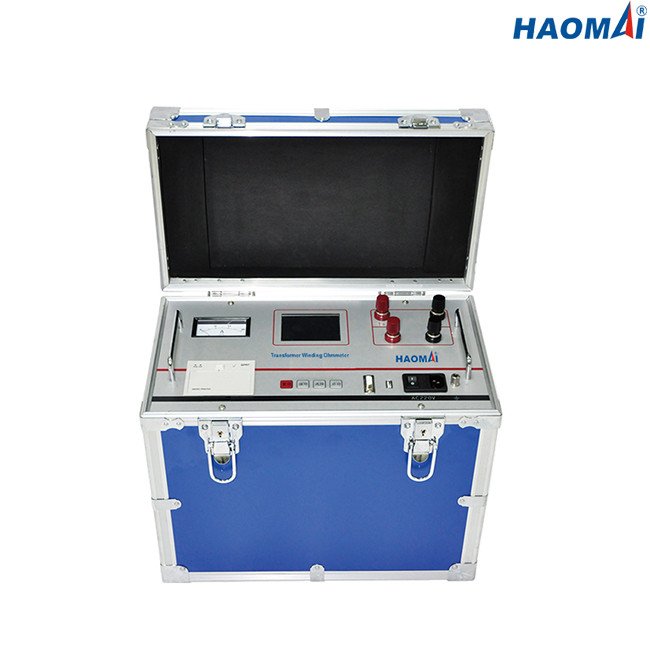
TWO-1100S
The TWO-1100S is a transformer winding ohmmeter that measures DC resistance of power and distribution transformer windings, rotating-machine…
- Max. test current 100
- Resistance range 30 µΩ – 4 Ω
- Accuracy ±0.2 % rdg ± 2 µΩ

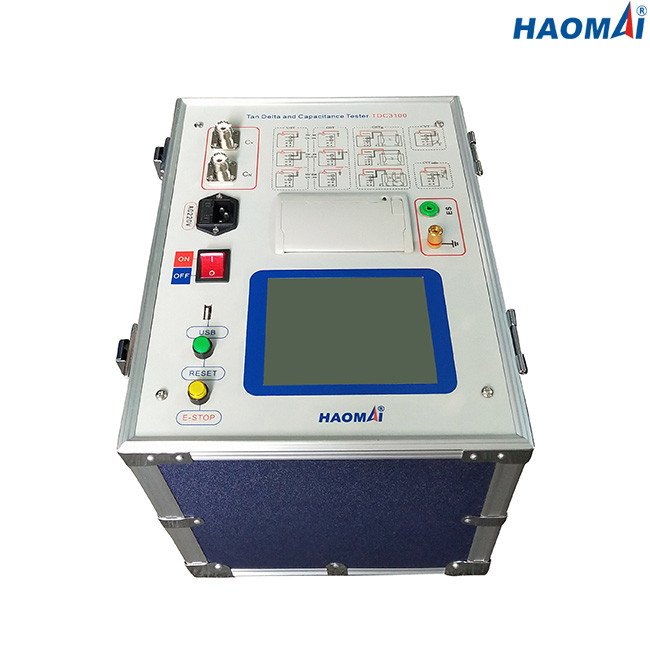
Tan Delta and Capacitance Tester
Fully automatic 12 kV insulation power-factor / dissipation-factor (tan δ) and capacitance test set with UST / GST / GSTg modes, CVT ratio testing and interference suppression — for transformers, bushings, breakers, cables, rotating machines and CVTs.
| Specification | Value | Unit |
|---|---|---|
| Test Standard | ||
| Test standard | IEC 60247 | |
| Internal HV Output | ||
| Output range | 0.5 – 12 | kV |
| Output accuracy | ±(reading × 1 %) | |
| Resolution | 100 | V |
| Maximum output current | 200 | mA |
| Capacity | 2000 | VA |
| Self-excitation Power Source | ||
| Output | AC 0 – 50 V / 15 A | |
| Dissipation Factor (tan δ) Measurement | ||
| Measuring range | No limit | |
| Accuracy | ±(reading × 1 % + 0.040 %) | |
| Resolution | 0.001 | % |
| Capacitance (Cx) Measurement | ||
| Measuring range | 15 pF – 60 nF (at 12 kV) | |
| Accuracy | ±(reading × 1 % + 1.00 pF) | |
| Resolution | 0.001 pF (4 valid digits) | |
| CVT Ratio Test | ||
| Measuring range | 10 – 10000 | |
| Accuracy | 1 % | |
| Suitability | CVT with accuracy class 1.0 or 3.0 | |
| Test Modes & Frequency | ||
| Test modes | UST · GST · GSTg (selectable) | |
| Single frequency | 50 Hz or 60 Hz | |
| Variable frequency | 45/55 Hz · 47.5/52.5 Hz · 55/65 Hz · 57.5/62.5 Hz | |
| Data Storage & Interface | ||
| Data storage | 200 test records on board | |
| Printing | Built-in thermal printer | |
| Data download | USB interface | |
| Power Supply & Environment | ||
| Power supply | Customized AC 220 V / 230 V / 120 V / 127 V ±10 %, 1-phase, 50/60 Hz | |
| Operating temperature | −10 … +50 | °C |
| Storage temperature | −20 … +60 | °C |
| Mechanical | ||
| Dimensions (host) | 350 × 270 × 270 | mm |
| Weight (host) | 22.8 | kg |
| Safety & EMC | ||
| Safety | Designed in accordance with IEC 61010-1 | |
| EMC | Light industrial IEC 61326 | |
Measures dissipation factor (tan δ), power factor, capacitance (Cx) and CVT ratio on transformers, bushings, circuit breakers, cables, rotating-machine windings and CVTs.
Selectable connection modes confine the measurement to the specific insulation under test, e.g. isolating a bushing from the winding.
0.5–12 kV output with ±(reading × 1 %) accuracy, 100 V resolution, up to 200 mA / 2000 VA.
AC 0–50 V / 15 A output extends test coverage without additional equipment.
15 pF – 60 nF range with ±(reading × 1 % + 1.00 pF) accuracy and 0.001 pF resolution.
Reduces test time while providing high-resolution, stable results.
Measures ratio of CVTs with accuracy class 1.0 or 3.0 across a 10–10000 range.
Suppression circuits keep results stable in noisy substation environments; 22.8 kg with touch-screen operation, thermal printer and USB download.
Dissipation-factor / power-factor and capacitance measurement to detect moisture, contamination and ageing.
Isolate bushing C1/C2 or winding-to-ground insulation for a targeted assessment of each insulation element.
Check the ratio of capacitive voltage transformers to detect failed or drifting capacitor elements.
Insulation condition assessment on cables, circuit breakers and machine windings.
Routine condition assessment and trending of high-voltage insulation health.
Dissipation factor (tan δ) is the ratio of the resistive (loss) current to the capacitive current of the insulation. Power factor (PF) is the cosine of the phase angle between the applied voltage and total current. For good insulation the two values are very close; the TDC-3100 reports both so results can be compared with either nameplate or historical convention.
UST (ungrounded specimen test) measures a specimen that is isolated from ground, GST (grounded specimen test) measures a grounded specimen, and GSTg (grounded specimen test with guard) adds a guard connection. They select how the high-voltage and measuring leads are connected so the measurement is confined to the insulation under test — for example isolating the bushing from the transformer winding.
Up to 12 kV is a common field test level for bushings, CVTs and other insulation. The output is adjustable from 0.5 kV in 100 V steps so the operator can match the test voltage to the component and site requirements.
A capacitive voltage transformer (CVT) divides voltage with a capacitive stack. Measuring its ratio checks the condition of the capacitor elements — a ratio change indicates failed or drifting elements. The TDC-3100 supports CVTs with accuracy class 1.0 or 3.0.
The TWO-1100S is a transformer winding ohmmeter that measures DC resistance of power and distribution transformer windings, rotating-machine…
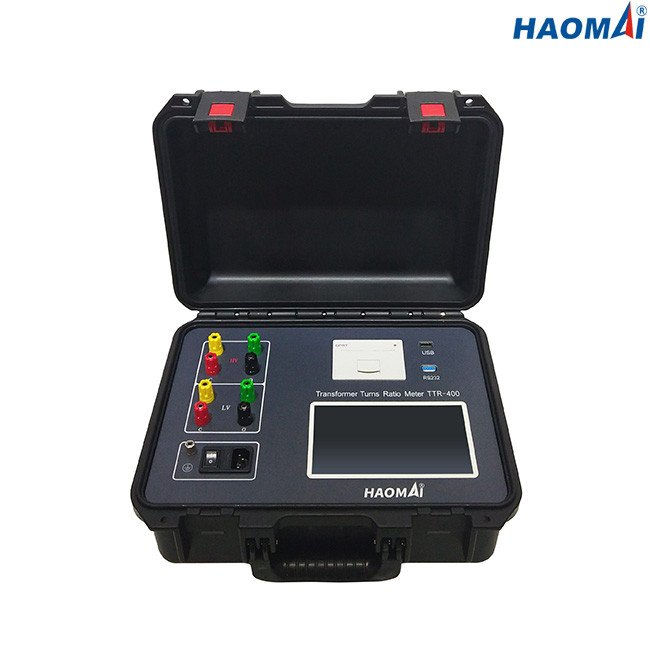
The TTR-400 is a portable transformer turns ratio meter that measures turns ratio, voltage ratio and phase displacement…
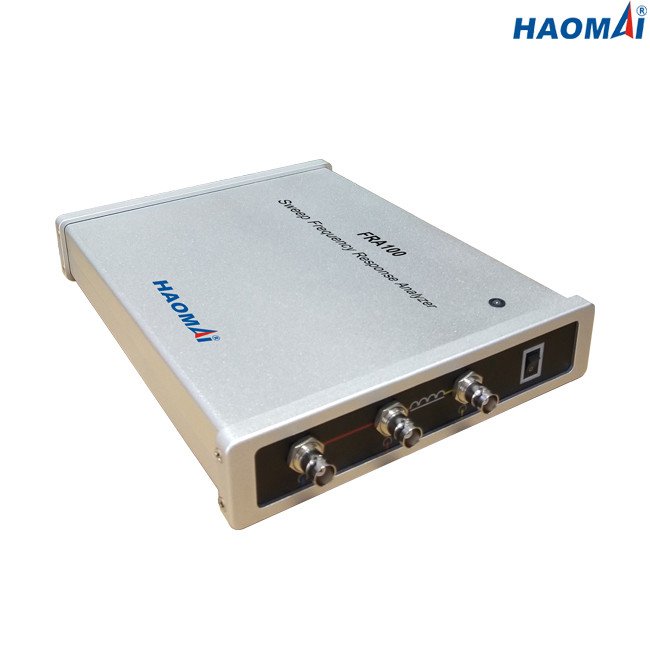
The FRA100 is a sweep frequency response analyzer (SFRA) that detects mechanical and electrical changes in the core…